Our News
College of Engineering at Fahad Bin Sultan University Wins the Prince Fahd bin Sultan Award for Excellence in Creativity and Innovation
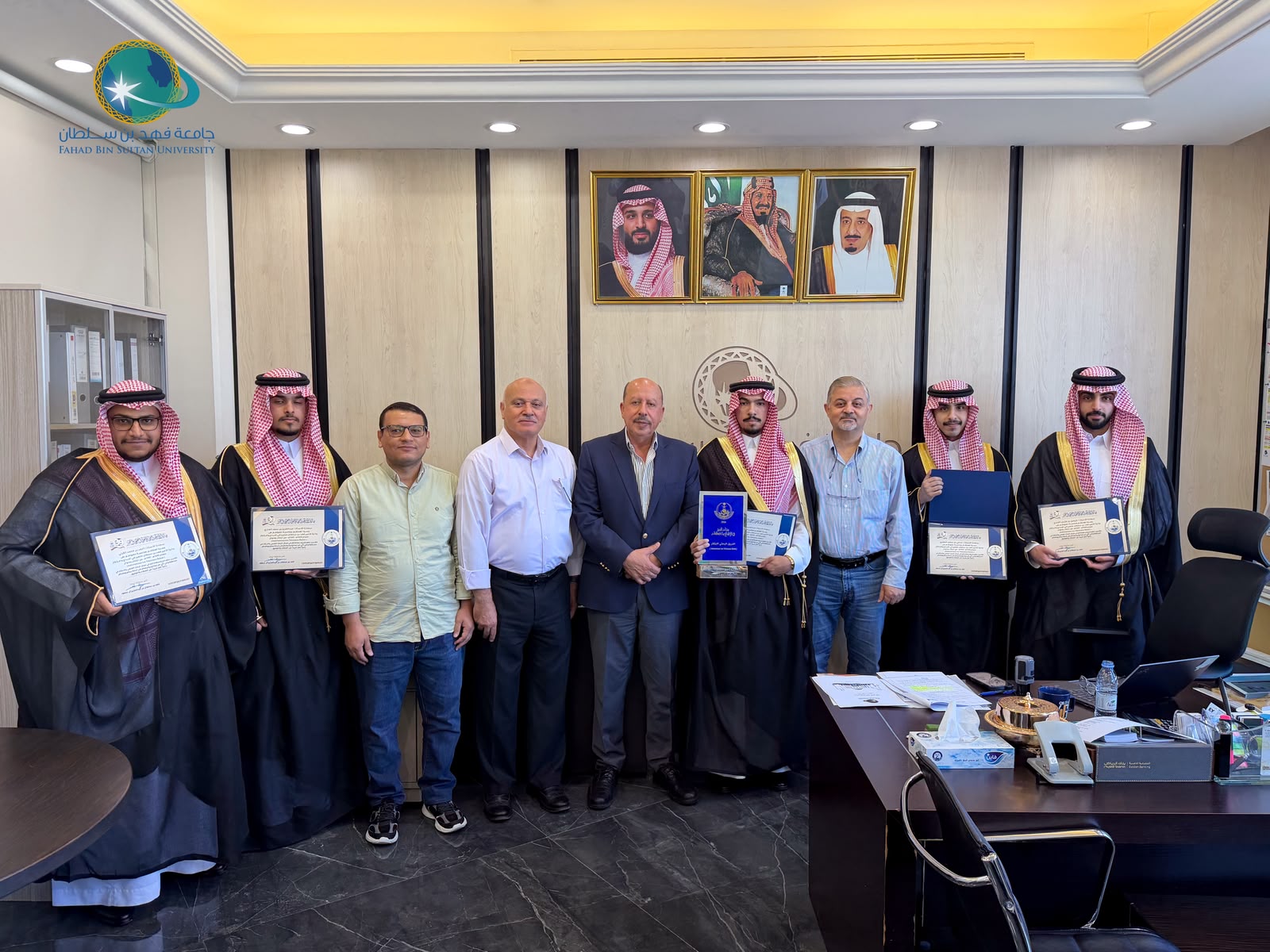
College of Engineering at Fahad Bin Sultan University Wins the Prince Fahd bin Sultan Award for Excellence in Creativity and Innovation
In a scientific and innovative achievement that reflects the University’s vision, represented by the College of Engineering, in utilizing engineering and modern technologies to address national needs, serve the community, and contribute to achieving the objectives of the National Transformation Plan 2030, a team of Mechanical Engineering students at Fahad Bin Sultan University has successfully developed a project entitled:
“Autonomous Tracked Robot Designed for Ice Thickness Detection at the NEOM Sport Center Ice Skating Field.”
The project team consisted of Sami Saeed Al-Omari, Faisal Fares Al-Anazi, Abdulaziz Saad Al-Anazi, Ahmed Mohammed Al-Qarni, and Abdulaziz Khalid Al-Qaier, under the supervision of Professor Dr. Jamal Nazzal and Dr. Abdul Nasser El-Sharkawy.
The project aims to enhance skater safety by developing a robot capable of conducting accurate and periodic measurements of ice thickness across different areas of indoor and mountain ice-skating facilities, while enabling the early detection of areas where ice thickness may be unsafe.
The system integrates a range of sensing technologies, including an Inertial Measurement Unit (IMU), LiDAR technology, Global Positioning System (GPS), and a specialized ice-thickness sensor. The robot utilizes a Raspberry Pi 5 to process data collected from the sensors, generate three-dimensional maps of the ice surface, determine the robot’s location, analyze ice thickness, and identify areas that may pose a risk to skaters, while also enabling the robot to navigate autonomously within the skating field.
The project represents an outstanding example of applying engineering knowledge to address real-world challenges. It also demonstrates the students’ capabilities in robotics, smart sensing, autonomous navigation, data processing, and systems engineering, in line with Saudi Arabia’s directions toward innovation and technological transformation.
This achievement further highlights the University’s commitment to supporting applied engineering projects that connect academic education with the needs of future-oriented sectors and facilities. It also contributes to preparing engineering professionals capable of developing innovative technological solutions that serve the community and enhance levels of safety and operational efficiency.